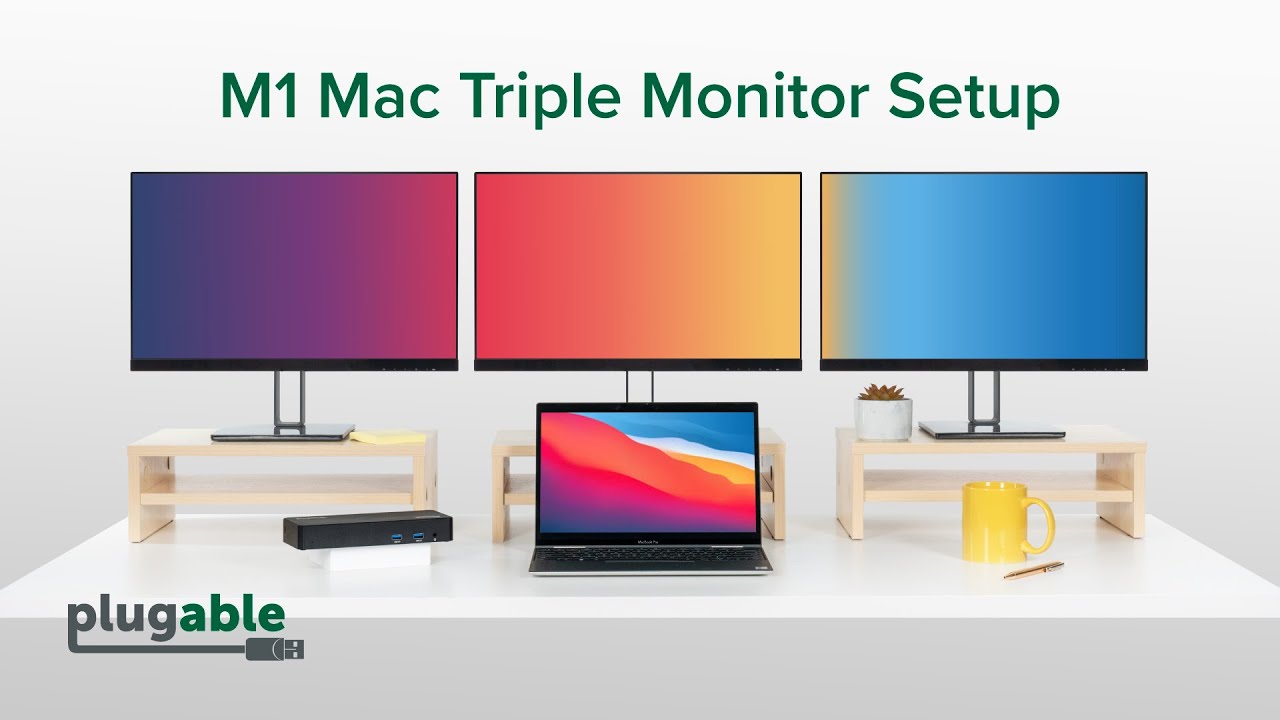
YouTube embed placeholder image

Updated for macOS Sequoia

Apple’s Mac Mini, MacBook Air, and MacBook Pro 13″, the first Macs to feature the Apple-designed M1 CPU, have a lot of potential across the board in comparison to their Intel-based counterparts. But there is one problem: a reduction in the number of external displays you can connect.

Per the specifications, the Mac Mini will natively support up to two external monitors (One via the HDMI port and a second via USB-C), while the MacBook Air and MacBook Pro 13″ only support one external display. Naturally, we wanted to see how accurate that was.

Sure enough, out of the box, these new computers work as described: one external screen on the MacBook Pro and Air when connected to our Thunderbolt docking stations that support 2 displays on Intel-based Macs. But when have we ever been satisfied with what it says on the box?

We found the trick for connecting multiple displays to your M1-powered Mac is a Plugable DisplayLink docking station.

With the release of Secoia, we've tested and updated our pick for the best docks for the M1 MacBook. 

The absolute best dock for the M1 MacBook is the Plugable UD-6950PDH. It brings 14-port expansion, including dual HDMI at 4K 60Hz. Plenty of ports. Plenty of productivity. 

Our other favorite dock for the M1 MacBook is the Plugable UD-ULTCDL. With 13 ports, including the ability to add three displays to M1 Macs, it's no wonder How-To Geek named it The Best of 2025. 

Note: These multi-display docks use a combination of USB-C Alternate Mode (native “Alt Mode” video output) and DisplayLink technology (requiring a driver to be installed). This combination of technologies serves as a workaround to the M1 platform only supporting a single external display via USB-C. For additional information about DisplayLink and macOS, please see our post here.

Questions on connections, or comments about anything else? Please let us know in the comments, we’d be happy to help.


How many monitors can an M1 Mac support natively?

The base M1 chip natively supports only one external display with up to 6K resolution at 60Hz. While the hardware includes powerful processing capabilities, the internal display controller in the entry-level M1 (found in the MacBook Air and 13" MacBook Pro) is limited to a single external video output over Thunderbolt. To connect more than one monitor, users must utilize "indirect" display technologies like DisplayLink.

What is the best docking station for M1 Mac dual monitors?

The Plugable UD-6950PDH is the ideal docking station for M1 Macs because it provides dual 4K 60Hz display support and 100W Power Delivery. This dock leverages DisplayLink technology to bypass the M1's single-display limit, allowing two independent HDMI or DisplayPort monitors to function through a single USB-C cable. For users who also need to charge their laptop while expanding their screen real estate, this "all-in-one" solution offers the best balance of performance and utility.

How to connect two external monitors to M1 MacBook Air?

To connect two external monitors to an M1 MacBook Air, you must use a DisplayLink-certified docking station or adapter and install the DisplayLink Manager software. 

  • Step 1: Connect a Plugable DisplayLink dock (like the UD-3900PDZ) to your MacBook Air.
  • Step 2: Download and install the latest DisplayLink Manager for macOS.
  • Step 3: Enable "Screen Recording" permissions in System Settings to allow the driver to render the pixels for the additional displays.

Do I need to keep my MacBook lid closed to use two monitors?

No, when using a Plugable DisplayLink docking station, you can use two external monitors while keeping your MacBook lid open for a triple-display experience. Unlike the newer M3 base models, which require "clamshell mode" to support two native displays, DisplayLink-powered setups work independently of the laptop's lid state.

Will DisplayLink affect the performance of my M1 Mac?

DisplayLink uses a small amount of CPU and GPU resources to compress and send video data, but the impact is negligible for standard office and productivity tasks. While it is not recommended for high-end gaming or professional color-grading, it is perfect for spreadsheets, web browsing, and video conferencing.


Loading Comments

Article ID: 395803066533